Wednesday, February 29, 2012

In honor of leap day: Give some love to kids working to save the most endangered frog in the US

According to the red list, the dusky gopher frog is one of the most critically endangered frog species in North America.  At one time, you could find this frog in the southern coastal plain from Louisiana to Mississippi.  Now, there are less than 250 left in two ponds in Mississippi.


When I buzzed around the web looking for a any non-profit organization dedicated to protecting the frog, I found something much more inspirational: a group of middle-school students in Gulfport, Mississippi that took it upon themselves to save the frog species.  Meet the Commodore Climate Changers:


"Three of the students found this Mississippi gopher frog online," she said. "It has only one habitat in the United States and it is here." 
Friday was the first day for the students to visit the site where they cut underbrush to make way for grass.
 These students are doing work on the ground to restore habitat, as well as increasing awareness in their school.

Give 'em some love on their facebook page.
 

Saturday, February 25, 2012

10 fun things to do with kids on a nature trail

1Nature bingo.  To head off any potential sibling discord, I put the wild animal poop on both cards.


2.  Nature alphabet photography.  To do the entire alphabet might take several trips, so here are some ideas for shorter attention spans:
  • Stick to the letters of their name.
  • Help nature along a bit by doing some letter arrangements with leaves, sticks, etc.
  • Shoot as many letters as they can find, and challenge them to make as many words as possible.

3.  Project Noah.  Upload pictures of your spottings of plants and wildlife to a community-based site where people all over the world are documenting biodiversity on a global scale.  Use your smartphone with a free app, or use a digital camera and upload pictures at home.  You can earn "patches" by the number of spottings or join a "mission" to document spottings for a cause.  If you have no idea what you've spotted, no worries, someone in the Project Noah community will help you identify it!
  

4. Free play with a Discovery Backpack - Do not even think about beginning this activity until you have done two things: A) put the oldest playclothes you possess on your child and B) make a plan for a direct route from the car to the bathtub when you get home (plastic for the car seat might be wise as well).  Then, let them go wild with tools of nature discovery.  Rest assured, giving your children uninhibited play in the wild is the absolute best thing you can do for their bodies, brains, and well-being.  This blog has a great list of items for the backpack that I can't possibly improve on.  Except maybe an underwater viewer.

5.  Who Pooped?  The multifunctional and fashionable SCAT SCARF is a must-have.  I know what the Easter bunny is bringing this year.


6. Greetings on the trail.  How many ways can you use natural materials to leave clever messages for the next trail adventurer?  Just be sure you leave no damage and that the messages can be washed away by rain or blown away by wind.

7.  Build a house for a fairy or an elf.


8.  Meet a tree game.  Blindfold your child and lead him/her to an interesting tree (yet another function for the scat scarf!).  Ask specific questions, like "Can you put your arms around it?", "Is the bark smooth or rough?" and "Do you feel any holes or big bumps?".  When your child is done exploring the tree, lead him/her back to the starting point by an indirect route.  Now, remove the blindfold and see if your child can find the tree!
 
9.  Flora and fauna identification apps.  Unfortunately the list does not include a scat app, but there are lots to choose from, including birds and tree leaves.

10.  Birder's Life List journal.  If you've got a budding bird-lover, here's a clip mosaic of some great ideas for making a personal birder's journal, where he or she can begin documenting lifetime bird sightings.  I would recommend starting with a spiral-bound book that can lay flat.  And how about a plastic zippered pocket to keep feathers?  Journaling tips from the birding community here.


Tuesday, February 14, 2012

Pascal. Miniaturized.

On the heels of the discovery of the world's smallest frog, comes the announcement of the discovery of the world's tiniest chameleon.  (You might recognize a chameleon if you are the parent of a daughter in the throes of Rapunzel-fever). 

The species, Brookesia micra, was found in remote rainforests of northern Matagascar.  They are considered "microendemic", which means that they are not only endemic (found in only one place on earth), but they are seriously endemic - this little guy can only be found on one island.

(As an aside, and because I am into pre-school humor, the island carries the unfortunate name of Nosy Hara).

Tuesday, January 31, 2012

Great biodiversity stuff I can't embed

The Great American Zoo Trip of endangered species in our zoos, courtesy National Geographic.  Be sure to check out the video, bottom left.  Power past your initial heebie jeebies, and then marvel at nature's beautiful and perfect design.

130 years of global climate change in 30 seconds, courtesy of NASA. 

Earth's Biggest, Fastest, and Bloodiest Insects, courtesy Wired Science.  To balance the karma, they included a "Best Dad" category.

Sunday, January 22, 2012

Fun with systematics

Word cloud of the taxonomic groups of 19,232 species new to science described in 2009:


Word cloud of new species

Ever wanted to be a marine biologist?

"Citizen Scientist" is one of the hottest buzzwords these days, reflecting a new trend toward involving citizens in real data collection efforts.  Budget cuts have forced organizations and agencies to think outside the box for gathering data, and many are creating training programs for citizen volunteers in a wide variety of scientific fields. 

There are many aspects of data collection that do not require advanced degrees in science, and give the public an opportunity to spend time in nature while contributing to knowledge.  In return, trained citizens become the first eyes and ears to notice and report when something is amiss.  By far the biggest benefit of training citizens to monitor lakes, streams, oceans, forests, and wildlife is that they are on the front line advocating for their community ecosystems. 

Sometimes the message is much more effective when it comes from a neighbor.

Here is a sampling of the plethora of ways that you can get involved in biodiversity monitoring with kids, starting with marine biology:

Sea Turtles!  If you live near a coast, chances are you can volunteer to monitor egg laying and hatching activity of sea turtles.  Here just a few of the many I ran across, including Florida, South Carolina, and Alabama.  Even if you are land-locked, you can volunteer to spend a week in the summer at the Wassaw National Wildlife Refuge.  And can you say Costa Rica?

Diving and snorkeling for the REEF survey project, where you can collect and report data on fishes, seaweeds, and other critters along the west coast of the US.  They have an online store with all of the gear and picture guides you need to get started.

Phytoplankton monitoring project hosted by NOAA across the US coasts and the great lakes.  The goal of the project is to gain more information on harmful algal blooms (or HABs).  Most microscopic phytoplankton are harmless, but there are a few species that bloom or produce toxins that are very dangerous to fish, birds, and marine mammals.  I know what you're thinking.  YES!  You get to use a microscope.  And there's an app.

Speaking of marine mammals, if you ever find yourself in Alaska you can combine the best of both worlds - a cruise and the chance to collect data on marine wildlife, including humpback whales!  Take a jacket.

If getting wet is not your thing, check out WhaleFM, an innovative new way to engage citizens in research.  Put on your listening ears, and help researchers classify whale sounds to increase our understanding of whale communication (another plug here).  Along the same lines, there's also Digital Fishers, developed by NEPTUNE Canada, where you analyze 15 second snippets of video taken from the deep sea.  Designed like a game, the 'player' answers questions about the scene, and can advance through levels that get more complex with more experience.

Birds!  The king of citizen science for birds is Cornell University Lab of Ornithology.  There are several options for volunteering, including eBird (for the serious birders), Project FeederWatch, PigeonWatch, and the Great Backyard Bird Count (from the comfort of your own home). 

Flutterbys.  Most people would be surprised to hear that butterfly populations have taken a hit from habitat loss.  Monarch Watch is asking volunteers to create 'monarch waystations' in backyards, parks, schoolyards, and vacant lots.  A waystation is a monarch habitat planted with their favorite delicacy, milkweed.  They can get you started with a seed kit designed for your region of the country.  Or, if you fancy yourself an amateur lepidopterist, or have keen photographic skills, consider volunteering for BAMONA and submit butterfly and moth sightings to their online database.

Who doesn't love ladybugs?  You can volunteer to monitor native ladybug populations that are at risk because of the relative success of ladybugs that were intentionally brought here from other continents.  Enter the Lost Ladybug Project, which has a wealth of fun and resources for their citizen scientists, including the Lost Ladybug Song.

Another group of insects where native species are battling introduced ones are ants.  School of Ants is an easy way to collect data on ant populations, and they offer instructions on making your own simple ant collecting kit with index cards, ziploc baggies, and cookies!   

Benthic macroinvertebrates, loosely translated, are spineless, bottom-dwelling creatures that can be seen with the naked eye.  If you have ever looked under a rock in a stream, you can catch sight of small crustaceans, immature insects, snails, and clams.  Some of them are very sensitive to pollution, and others can handle it, so they are good indicators of water quality.  Many states have Stream Teams, and the like, where citizens are trained to collect and identify benthic macroinvertebrates.

Sunday, January 1, 2012

World's tiniest frog - a new record

About the size of a Tic Tac, these miniaturized frogs were discovered in the forests of southeastern Papua New Guinea.  One of the two new species of frogs was given the scientific name Paedophryne dekot.  The species name 'dekot' is the word for "very small" in Daga, the native language. (photo credit: Kraus, 2011)


Saturday, December 31, 2011

Wolves changing Yellowstone

Biologists call it a "trophic cascade".  Wolves, a top predator, were re-introduced into Yellowstone National Park in the mid-90's and we are now seeing reverberations all the way down the food chain.

Here's how it works.  Because the wolves prey on elk, the elk population has dropped from nearly 20,000 in 1994 to about 6,100 in 2010.

Because elk have a taste for aspen, willow, and other trees, their populations have shot up.  Here are two photos showing the change in the aspen population in just the last five years and the aspen saplings that would never have survived grazing by a massive population of elk. (Photo credit: Ripple and Beschta, 2011)


And there's more.  The beaver populations benefit from more willows.  The streams will benefit from more beavers.  The songbirds benefit from more aspens.  The bison poplations are increasing because they don't have to compete with a massive population of elk anymore...you get the idea.

We are getting a first glimse of historical Yellowstone.  All this from less than 100 wolves.   Phenomenal.

(Source; pdf)

Friday, December 30, 2011

Live action wildlife cams

Screen time with biodiversity:

Butterfly cam - American Museum of Natural History

Naked mole-ratcam - Smithsonian National Zoo

Penguin cam - California Academy of Sciences

Rainforest cam - Brazil

Sea Otter cam - Monterey Bay Aquarium

Leafcutter ant cam - Natural History Museum, London

Polar bear cam - San Diego Zoo

Tuesday, December 13, 2011

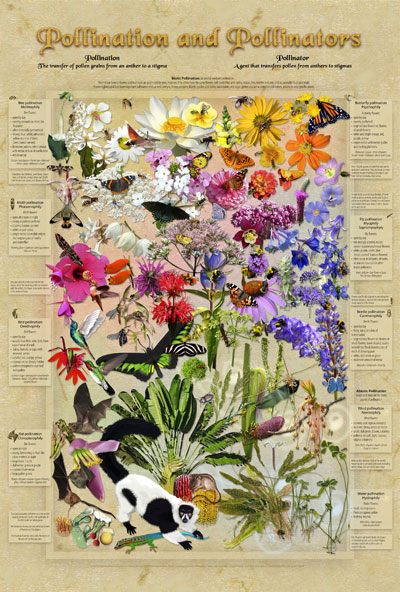
Biodiversity posters for a kid's room

Found some amazing posters that would look great on a wall in the kid's room (or for your living room for that matter!)

pollination poster

Life on the Seamounts


Uko Gorter's Whale, Dolphin & Porpoise Poster


SHARKS POSTER ~ LAMINATED

Monday, December 12, 2011

Connecting all of the dots

Green living usually means two things: either you are trying to save the "environment", or you are trying to protect your health. Many times an action does both, sometimes not. But, almost always, they both protect biodiversity.
Think that new vinyl smell is bad for your health? Probably not so good for other vertebrates either.
...(L)aboratory studies indicate phthalates cause a broad range of birth defects and reproductive impairments in animals exposed in utero and shortly after birth (e.g. Marsman 1995; Wine 1997; Ema 1998; Mylchreest 1998, 1999, 2000; Gray 1999; CERHR 2000). Phthalate exposures damage the testes, prostate gland, epididymis, penis, and seminal vesicles in laboratory animals (e.g. Mylchreest 1998); most of these effects persist throughout the animal's life. Phthalates have also been shown to bioaccumulate in fish tissue and to affect estrogen levels in fish (Jobling 1995).
Prefer organic food for your kids? Also better for nearby birds and other wildlife.
It is estimated that of the roughly 672 million birds exposed annually to pesticides on U.S. agricultural lands, 10%– or 67 million– are killed. This staggering number is a conservative estimate that takes into account only birds that inhabit farmlands, and only birds killed outright by ingestion of pesticides. The full extent of bird fatalities due to pesticides is extremely difficult to determine because most deaths go undetected.
Giving up number 7 plastic? The amphibians will thank you.
A new study reveals that by interfering with thyroid hormone, exposure to low levels of bisphenol A (BPA) slows the rate at which tadpoles develop into frogs. Thyroid signals are necessary both for normal frog metamorphosis and for human development. In these experiments, exposure levels similar to those found in human infants kept certain genes from turning on, thus delaying tadpole development.

Wednesday, November 30, 2011

The coolest citizen science project ever.

The number of ways that citizens can contribute to real research is many and, because of budget cuts, growing.  I promise a post is coming soon covering the full plethora of ways you can volunteer.  In the meantime, this has to be the top of my list.

The Whale Song Project is asking the public to help marine researchers understand whale communication.  Volunteers listen to calls from killer whales and pilot whales, and then try to match the distincive sounds to other calls in the database. 

Whales

Tuesday, November 29, 2011

Green gifts for kids

Great ideas for gifts for kids that support wildlife and protect biodiversity, with bonus 'stuff' that kids love.  BTW - all of these are Four Star charities according to Charity Navigator:

Oceana:


World Wildlife Fund:


Snow Leopard Trust:

Mongolian Ornaments

Sea Turtle Conservancy:

Swimming Lesson Jigsaw Puzzle

Dian Fossey Gorilla Fund International:

Sunday, November 27, 2011

What is biodiversity?

Species of life on earth

When someone says ‘biodiversity’, what is the first thing that comes to your mind?


According to the Convention on Biological Diversity, about 1.75 million species of plants, animals, and microorganisms have been identified, and there may be as many as 13 million different species on earth.

From the tiny bacteria in the deep of the ocean to the algae that grow in the snow at the poles, all species are vitally important to the balance of the ecosystems in which they evolved.

One of my favorites. The indomitable
Water Bear.
Can survive from -200 to 151°C and remain in a completely dry state for up to 100 years. Can survive boiling alcohol and the vacuum and radiation of space. Can find them in your backyard.

Saturday, November 26, 2011

Inaugural post

The one process now going on that will take millions of years to correct is the loss of genetic and species diversity by the destruction of natural habitats. This is the folly our descendants are least likely to forgive us. -E.O. Wilson